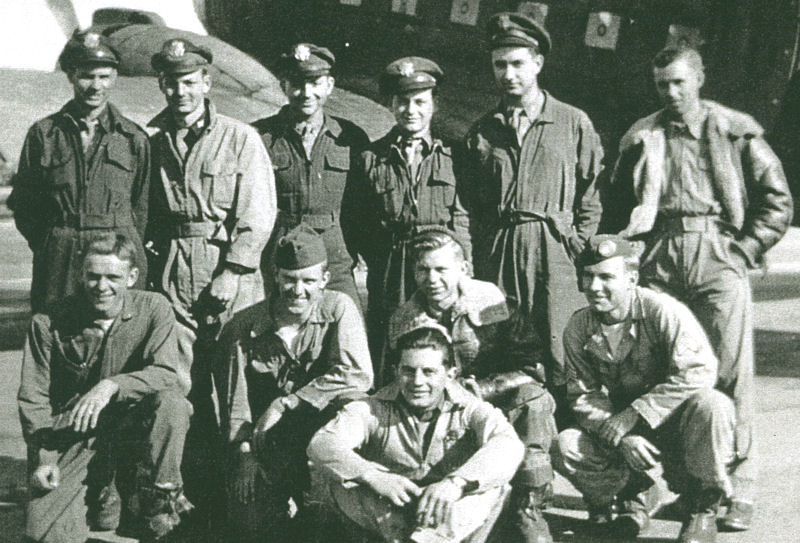
Crew 16 went
down on their first bombing mission the target was Saeki Airfield, Kyushu. They were approximately 20 miles north of Iwo Jima at 10,000 ft. The weaher had broken clouds at 1,000 ft ceiling with visibilty at 12 miles.
According to Air Sea Rescue Report No. 5 there was no indication of any trouble before the fire started. No one in the plane smelled or saw any smoke before the fire broke out. The fire was first seen by the Radio Operator (Anderson) in the vicinity of the voltage regulators under the Liaison Radio. The flames looked as if they were coming off the floor.
Anderson (the radio operator) notified the crew in the nose by voice. Steps were immediately taken to put out the fire with the extinguisher. The flames were out for a moment but started again and the extinguisher was empty. The Radio Operator made attempts to smother the flames with a flak curtain but could not get at it to do any good.
A state of emergency was declared by the Pilot (Edwards). There was no electrical power as soon as the fire started. The pilot hit the gear switch to get the nose gear down and hit the alarm bell. The alarm bell gave one very loud short ring, but the nose gear did not start down. The Co-Pilot (Hetherington) tried to call a buddy ship but the radio was out and also the intephone became inoperative.
The Bombardier (Engholdt), Engineer (Clark) and Navigator (Fields) were attempting to crank the nose gear by hand. There was a great deal of smoke in the nose of the plane. It was the whitish grey smoke and very irritating. The windows in the pilot's compartment were tried open and closed with no noticable changes in smoke.
The Co-Pilot not seeing that the efforts of the crew to get the nose gear down were not going well, and hewas coughing a great deal and couldn't see very well, lef the co-pilot's seat to go back to the bomb bay door to get some air. The co-pilot saw the CFC Gunner (Arundale) going through the tunnel to tel the men in the back to bail out. The Radio Operator (Anderson) jumped down on the bomb bay and pulled the emergency handle. The doors opened he fell out. The co-pilot was standing on the cat walk and was just going back inside when the navigator (Fields) came out and jumped. He was so badly burned that he was hardly recognizable. The fire increased in intensity a great deal in about 15 seconds.
When the Co-Pilot had come out the flames were coming out under the top turret but when he stared to go back the flames were all over the turret with intense heat; so he turned around and jumped. The Navigator had tried to bring the Engineer (Clark) back with him but he wouldn't go though the fire. The Left Gunner (O'Brien) heard the alarm bell, fastened his parachute and started for the rear escape hatch, telling the Right Gunner (Nyholm) to follow him. The Right Gunner had started to get a fire extinguisher to take up front. The Radar Officer (Kelly) was in his chute and fastening on his dinghy when the left gunner got back to the radar room. He told him someone had bailed out of the front and to jump. Two men, the Radar Man (Kelly) and Right Gunner (Nyholm), were standing behind the Left Gunner (O'Brien) when he jumped. The Co-Pilot jumped and pulled the cord when he saw he was clear of the plane. The plane came back around in a circle and the whole nose was on fire, flames coming out the top and right side of the fuselage. About a ninety degree turn more it blew up before hitting the water.
The Co-Pilot (Hetherington) saw four other chutes below him and just before the explosion another one was open quite low and close to the plane, therefore, the Co-Pilot was certain that six got out of the plane.
The Co-Pilot, Navigator (Fields) and Radio Operator (Anderson) bailed out through the front bomb bay. The Left Gunner bailed out through the rear escape hatch.
Swells were from 10-15 ft high. Other B-29s which saw the men parachuting out radioed in their position. The survivors had been in the water 10 minutes when they saw planes flying low over head.
A Navy PBY spotted the co-pilot and dropped sea marker dye and smoke bombs. The co-pilot was in his dinghy approximately two minutes after contact with the water. He paddled about ten feet, got his parachute and dropped it over his dinghy. It was very easily spotted from the air and worked well as a sea anchor. The Co-Pilot did not drift at all and stayed in the same position as the dye marker.
The Navigator had only his Mae West and had considerable trouble inflating it. His hands were severely burned, also his head and arms. It took him about about thirty minutes to inflate his Mae West. A PBY spotted him and dropped a five man dinghy near him, to which he swam and got into with quite a lot of touble due to his weak condition.
The Left Gunner had his dinghy. He was spotted by rescue planes and marker bombs and sea markers were dropped.
The Radio Operator did not have his dinghy as it was lost in the fire but he had his Mae West. He was not spotted by any rescue planes. Planes flew directly over him several times. No sea marker or smoke bombs were dropped by him.
A mine sweeper had been sent out immediately and a destroyer escort soom after. The mine sweeper arrived first on scene. It picked up the navigator first who was about five miles from the co-pilot. It then came cover and picked up the co-pilot. The radio operator was picked up about 15 minutes later by luck, someone saw something out quite a ways and it was he swimming. The destroyer escort was at the scene by this time and picked up the left gunner.
Although efforts were made unitl dark to pick up the other men, no one was found. There was considerable wreckage still floating where the plane went down. In the area near the wreckage a number of large sharks were seen.
The two ships stayed out until dark and then the survivors were transferred to the destroyer escort and taken into Iwo Jima so that the navigator could have better medical attention. The mine sweeper anchored in the vicinity of the wreckage and continued the search the next day, but no further survivors were found.
|